Nuclear energy should be part of our carbon-free future
Massachusetts is positioned to be a leader as a new generation of safer nuclear technology takes hold
By Kevin Knobloch and Armond Cohen
Massachusets has always solved big challenges. And there is no bigger challenge than creating a reliable, carbon-free energy system while serving an electrified, data-driven innovation economy.
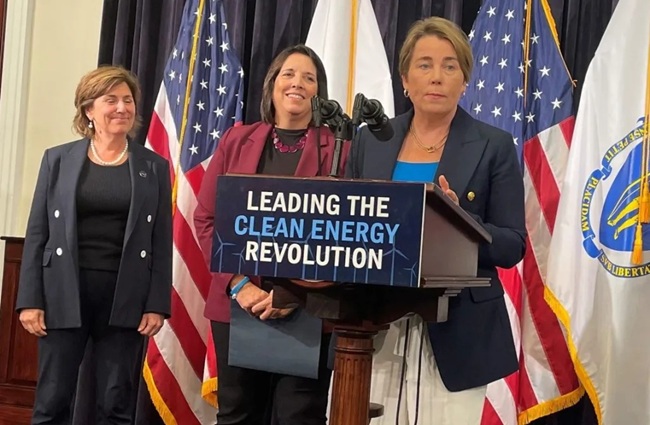
That’s why, as longtime climate protection advocates, we applaud Gov. Maura Healey for asking the University of Massachusetts Lowell to map potential pathways for advanced nuclear fission and fusion energy in the Bay State.
Led by Sukesh Aghara, associate dean of UMass Lowell’s Francis College of Engineering, the nuclear energy roadmap project will hold the last of a series of webinars to brief interested communities and stakeholders about its goals and process on Wednesday, December 10, at noon. Stakeholder group meetings for nine focus areas have also been scheduled from December 9 through January 9 to help guide the roadmap’s development.
The challenge is huge. To meet our climate goals, we have to reduce our reliance on burning fossil fuels by electrifying our transportation, buildings, and industry, while meeting new electrical demands from AI infrastructure and other cybereconomy applications. That means we need to double our capacity while eliminating fossil fuel emissions from our grid.
The scale involved is staggering. To take one example, meeting the Bay State’s climate goals by adding offshore wind would require commissioning a mammoth new offshore wind farm – one and a half times the size of Vineyard Wind – every year from now until 2050.
Renewable energy is an essential piece of the puzzle, but it can’t meet all of our demand reliably at reasonable cost. Solar energy provides about 5 percent of our in-state power today and wind energy less than 1 percent.
We can and should expand those sources. But a zero-carbon grid will be more achievable if we are able to add clean energy sources that can run 24/7/365. Deep advanced geothermal energy is one such option, as is additional hydropower from Quebec and gas with carbon sequestration. But deep geothermal is still in early stages, hydro is limited by Canada’s own needs and transmission constraints, while carbon sequestration geology is limited in our region.
That leaves a major opening for nuclear energy. You may be surprised to learn that Massachusetts already gets a quarter of its electricity from nuclear energy. But those electrons come from nuclear power plants in New Hampshire and Connecticut since, in 2019, we closed our last in-state nuclear power plant, Pilgrim Nuclear Power Station in Plymouth, at the end of nearly 50 years generating zero-carbon electricity.
Nuclear technology has evolved dramatically since the Pilgrim-era reactors started operation in the 1970s. Westinghouse’s gigawatt-scale AP1000 reactor, two of which were recently commissioned and are running well in Georgia, is based on “passive safety” principles. It can shut down and release excess heat without intervention from operators, thus further minimizing the prospect of meltdowns that accompanied earlier generations of nuclear reactors.
Advanced small modular reactors (SMRs) now being demonstrated offer other advantages such as accident tolerant fuels and small unit sizes that can be deployed incrementally for municipalities, factory complexes, data centers, military bases, and university campuses –and to better equip utilities to respond to heat waves and deep-freeze spells.
Massachusetts is well-prepared to lead this new wave. One of our all-star homegrown companies, Cambridge-based GE Vernova, is on track to build four of its BWRX-300 SMRs in Ontario and is well positioned to start building SMRs here in the US. MIT ranks second in the country among nuclear engineering programs, while UMass Lowell’s Nuclear Engineering and Science program is also among the top programs nationally. Both institutions operate small-scale research nuclear reactors.
We also lead on an exciting new technology: fusion energy. Unlike today’s nuclear fission plants, a fusion plant fuses rather than splits atoms, a process which avoids the tricky challenge of controlling a fission chain reaction and can substantially reduce the generation of radioactive waste. Commonwealth Fusion Systems, an MIT spinoff, is capitalized with $3 billion and could be the first private company to produce net fusion energy in their pilot plant in Devens.
As longtime environmentalists, we appreciate the history of opposition to nuclear energy in the US, which dates to at least the Three Mile Island reactor accident in 1979. But today’s realities are different: Climate change risks are increasingly more urgent to address, electricity demand is growing faster than renewable deployment, and the US reactor fleet has a strong safety record built over the past 25 years, with advanced nuclear designs promising even greater safety. In this context, we believe it’s time for an updated consideration of this zero-carbon energy solution.
Yes, nuclear energy has its challenges. Recent “one off” nuclear plants have proven expensive, so we need to move toward standardized plants as part of a regional and national program. We need to rebuild the supply chain and workforce. And we need to resolve the nuclear waste question through the creation of multiple long-term regional repositories powered by a consent-based siting process, as the governments of Finland, Sweden, and Canada have. The US Department of Energy has begun a similar process.
We welcome the exploration of the role of nuclear energy in the Bay State and have confidence that Massachusetts will once again rise to a critical challenge.
Kevin Knobloch is former chief of staff at the US Department of Energy and former president of the Union of Concerned Scientists. Armond Cohen is executive director of the Clean Air Task Force, a global environmental organization headquartered in Boston.

CommonWealth Voices is sponsored by The Boston Foundation.
The Boston Foundation is deeply committed to civic leadership, and essential to our work is the exchange of informed opinions. We are proud to partner on a platform that engages such a broad range of demographic and ideological viewpoints.