
How Boston – of all places – offers lessons for the NFL on hiring diversity
From the Celtics to the C-suites, the city has learned, sometimes the hard way, what it takes to achieve real leadership inclusion
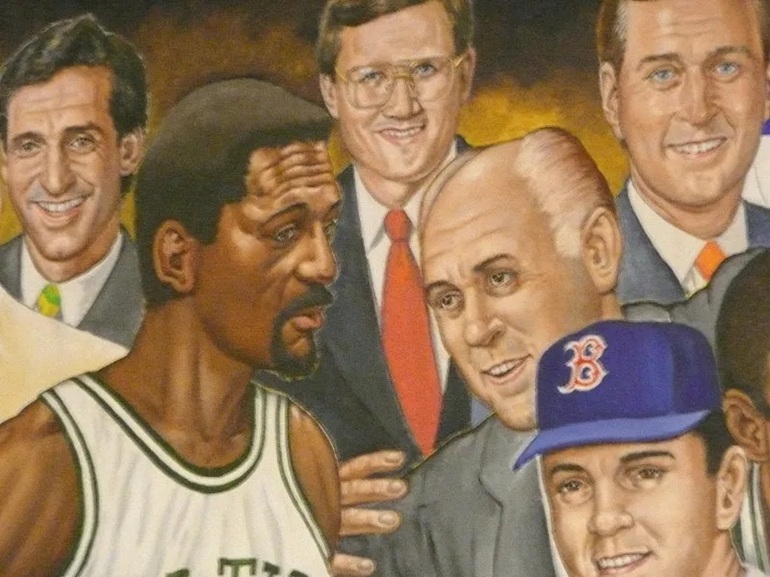
Bill Russell and Red Auerbach on a mural of Boston sports legends at the Sports Museum at the TD Garden. (Photo via Creative Commons/Flickr by Lorianne DiSabato)
Over the past week, much of the sports focus nationally—and nearly all of it in New England—has been on the Super Bowl. But while excitement was building and we were busy planning our best 7-layer dips and other watch-party staples, the NFL found itself confronting a familiar and uncomfortable reality: Another head coach hiring cycle came and went, and only a single vacancy was filled by a person of color.
The ensuing media coverage and handwringing was predictable. What may be surprising to many is that Boston—a city not seen as a leading light on matters of race in recent decades—turns out to offer some sound lessons in how the NFL, or any organization grappling with these issues, can effectively address hiring diversity.
To its credit, the NFL – where a majority of players are Black — has tried. Since 2003, the league has championed what’s come to be known as the Rooney Rule, which requires teams to interview at least two minority candidates for vacant head coach positions.
This year had a surprisingly large number of vacancies – 10 teams parted ways with their coaches at the end of the season. After a flurry of activity to fill all the positions, however, no Black candidates were hired and only one candidate of color, Robert Saleh, the son of Lebanese immigrants, was tapped to lead a team.
The question now, as always, is whether the Rooney Rule’s mandated interviews with candidates of color are real or merely performative “check-the-box” exercises?
After 23 years, it’s clear that most head coach hiring decisions are effectively made before interviews ever begin, with the Rooney Rule simply regulating the most visible part of the process: interviews. What the rule, however well-intentioned, doesn’t address is the invisible part, where real trust is formed and decisions are shaped long before anyone sits down across a table. Boston has long grappled with this same challenge – but with some surprisingly positive outcomes.
The Celtics are, in many ways, a model of what sustained inclusion can look like in professional sports. The team’s last two head coaches have been Black. Long before that, ML Carr and KC Jones coached the team – the latter to two championships. And of course, Red Auerbach hired Bill Russell in 1966, making him the first Black head coach in modern professional sports.
The Celtics’ history matters not because it was virtuous, but because it was normalizing. Auerbach didn’t treat Russell’s leadership as an exception. And over time, the Celtics, and the NBA, built an internal culture in which Black authority on the sidelines was neither novel nor risky – but just part of how leadership looked.
The NFL, by contrast, still too often approaches its lack of Black head coaches less as an opportunity to gain an advantage than as an HR problem to be managed. This pattern should feel familiar to anyone who has spent time in Boston’s business or civic leadership circles.
For decades, our city’s power structures have operated through tight, parochial, relationship-driven networks. Leadership opportunity in our institutions flows through who is known and trusted, who has already been invited into informal rooms where decisions begin to take shape, and who is vouched for by trusted advisors.
In my 30-plus years of experience in Boston’s C-suites and boardrooms, the most effective responses don’t focus on the final decision point. They focus upstream. That is precisely why I started my cross-cultural networking group, Get Konnected!.
The idea was simple: creating regular, sustained exposure between established leaders and emerging talent builds trust and familiarity long before promotions are on the line. That approach has produced measurable results in Boston institutions, including companies like Eastern Bank and American Tower that had historically struggled to diversify leadership.
If the NFL wants the Rooney Rule to work as intended—or simply to avoid its annual media lashing—it should focus on owners, not teams, for whom trust is built socially, not transactionally. Indeed, Patriots owner Robert Kraft has long been known for cultivating unusually close personal relationships with players – through philanthropy, his “Touchdown in Israel” trips, and other ways that build trust, loyalty and familiarity.
Instead of focusing almost exclusively on interview requirements, the league could expand the Rooney Rule to place greater emphasis on ownership exposure and relationship-building outside hiring cycles. That could mean structured, off-season leadership forums involving owners and coordinator-level candidates – or better tracking of developmental opportunities that bring ownership into the process earlier.
By the time a leadership interview takes place, as Eastern Bank CEO Bob Rivers has argued, an owner shouldn’t be meeting a candidate for the first or second time. They should already know that person – how they think, lead, and perform under pressure.
Boston has learned, slowly and imperfectly, that inclusion doesn’t happen at the finish line.
As the Patriots once again take center stage in the Super Bowl, it’s worth remembering that sustained excellence rarely comes from last-minute decisions. It comes from institutions and leaders who invest in pipelines and relationships long before the spotlight arrives.
Colette A.M. Phillips is president and CEO of Colette Phillips Communications, Inc., a communications and inclusion-focused consulting firm, and the author of the book The Includers: The 7 Traits of Culturally Savvy Anti-Racist Leaders. She is a member of the CommonWealth Beacon editorial advisory board.

CommonWealth Voices is sponsored by The Boston Foundation.
The Boston Foundation is deeply committed to civic leadership, and essential to our work is the exchange of informed opinions. We are proud to partner on a platform that engages such a broad range of demographic and ideological viewpoints.