
RI’s Copy of the Declaration of Independence to Visit the Bristol Historical & Preservation Society in Honor of the RI250
FREE AND OPEN TO THE PUBLIC
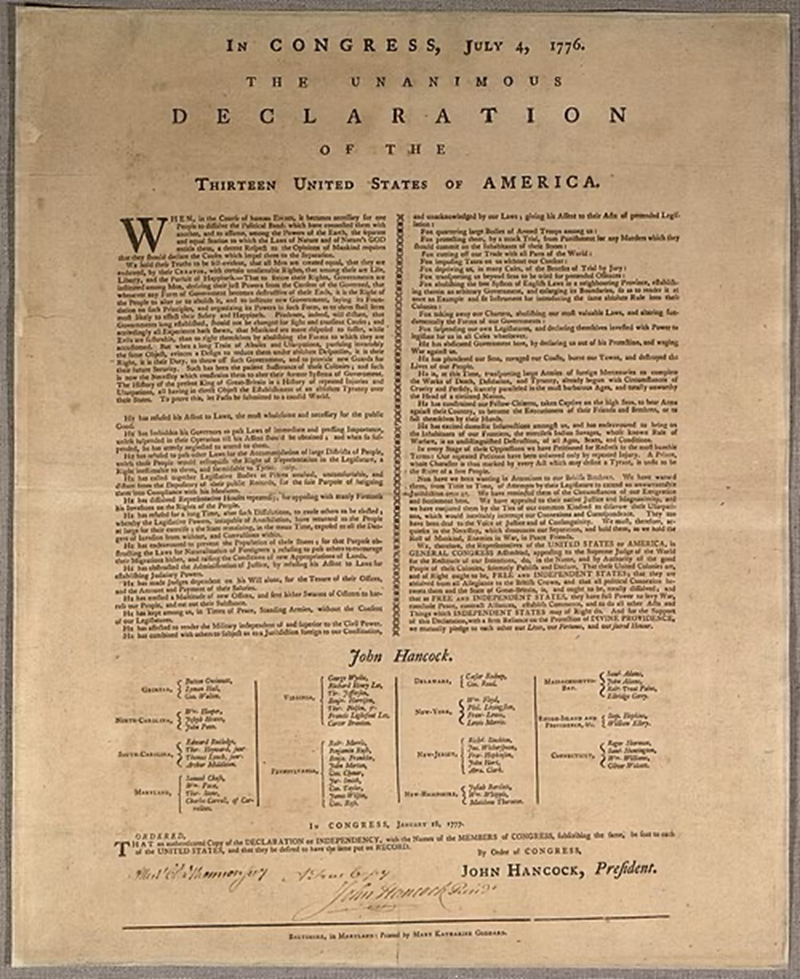
Open House Display: The Declaration of Independence, in Bristol, RI
Date: July 1, 2-4pm
Location: BH&PS HQ, 48 Court St., Bristol, RI 02809
Sponsored By: The Bristol Historical & Preservation Society, The Bristol 250 Commission and the Rhode Island Semiquincentennial Commission (RI250).
Free and open to the public!
The Bristol Historical & Preservation Society is proud to host an open-house viewing of Rhode Island’s Copy of the Declaration of Independence. Printed by Mary Katharine Goddard and held in the collections of the Rhode Island State Archives, the Declaration will make its way to Bristol on July 1 in celebration of the RI250. The document will be available for public viewing between 2pm and 4pm at the BH&PS headquarters building, 48 Court Street, Bristol, RI.
While on display, the BH&PS has planned an accompanying program of historical festivities, which will take place in the BH&PS’s side yard. These will include crafts for kids (of all ages), Colonial-era dress up, spinning and weaving demonstrations, military drills and military gear demonstrations, and a performance of historic music by the Tautogs. Celebrating in Bristol fashion, Bristol Town Cryer Michael Reilly will move throughout the Town telling the news of this important document and the Bristol Train of Artillery will be on hand with demonstrations of their equipment (and to ensure the British don’t return).
“We are so excited to host an open house viewing of Rhode Island’s copy of the Declaration of Independence,” said BH&PS Director Catherine W. Zipf. “This once-in-a-lifetime opportunity to see the Declaration in person shouldn’t be missed and we are thrilled to be able to offer our community this amazing opportunity.”
About the Declaration of Independence:
The Declaration of Independence is the founding document of the United States. On July 4, 1776, it was adopted unanimously by the Second Continental Congress, who were convened at the Pennsylvania State House in Philadelphia, PA. The Declaration explains why the Thirteen Colonies regarded themselves as independent sovereign states no longer subject to British colonial rule, and has become one of the most circulated, reprinted, and influential documents in history.
On June 11, 1776, Congress appointed the Committee of Five (John Adams, Benjamin Franklin, Thomas Jefferson, Robert R. Livingston, and Roger Sherman) to draft and present the Declaration. Jefferson largely wrote the Declaration between June 11 and 28, 1776. The Declaration offered the political, moral, and legal justification for independence from the Kingdom of Great Britain and justified the independence of the colonies, citing 27 colonial grievances against the king and asserting certain natural and legal rights, including a right of revolution.
The Declaration was unanimously ratified on July 4 by the Second Continental Congress, whose delegates represented each of the Thirteen Colonies. In ratifying and signing it, the delegates knew they were committing an act of high treason against The Crown, which was punishable by torture and death. The first public readings of the Declaration occurred simultaneously on July 8, 1776, at noon, at three previously designated locations: in Trenton, New Jersey; Easton, Pennsylvania; and Philadelphia.
The Declaration has proven an influential and globally impactful statement on human rights. The Declaration was viewed by Abraham Lincoln as the moral standard to which the United States should strive, and he considered it a statement of principles through which the Constitution should be interpreted. The Declaration’s second sentence, “We hold these truths to be self-evident, that all men are created equal, that they are endowed by their Creator with certain unalienable Rights, that among these are Life, Liberty and the pursuit of Happiness”, is considered one of the most significant and famed lines in world history. Pulitzer Prize-winning historian Joseph Ellis has written that the Declaration contains “the most potent and consequential words in American history”.
In 1780, the Reverend Henry Wight, of Bristol’s First Congregational Church, perpetuated this history by offering a public reading of the Declaration of Independence. This event marked the beginning of Bristol’s Fourth of July festivities, which have continued for 241 years and and which have included subsequent readings of the Declaration of Independence as part of the ceremonies.
Goddard Broadside of the Declaration of Independence, with “Printed by Mary Katharine Goddard” at bottom
About Mary Katharine Goddard
Mary Katharine Goddard (1738-1816) was an early American publisher, and the postmaster of the Baltimore Post Office from 1775 to 1789. She was the second printer to print the Declaration of Independence. Her copy, the Goddard Broadside, was commissioned by Congress in 1777, and was the first to include the names of the signatories.
The Goddard family (Mary Katharine, her mother Sarah Updike Goddard, and her brother William Goddard) set up a printing press and were the first to publish a newspaper in Providence, Rhode Island, called The Providence Gazette. When William left Rhode Island to start a newspaper in Philadelphia. Mary Goddard took over control of the journal in 1774 and continued to publish it throughout the American Revolutionary War. Mary Goddard was very active in the American Revolution, on the side of the colonial revolutionaries, via her printing. Goddard reprinted Thomas Paine’s Common Sense in her publication, and she wrote and printed editorials speaking out against British brutality. Additionally, Goddard released publications about the Battle of Bunker Hill and Congress’s call to arms.
When, on January 18, 1777, the Second Continental Congress moved that the Declaration of Independence be widely distributed, Goddard was one of the first to offer the use of her press, in spite of the risks of being associated with what was considered a treasonous document by the British. Her copy, the Goddard Broadside, was the second printed, and the first to contain the typeset names of the signatories, including John Hancock. The names of secretary Charles Thomson and president John Hancock of the Continental Congress were the only two that were on earlier printed copies. Goddard also signed her name on the bottom of the document. It reads “Baltimore, in Maryland: Printed by Mary Katharine Goddard.”
Goddard died August 12, 1816. Upon her death, Goddard’s will posthumously freed her enslaved woman, Belinda Starling, and bequeathed to her all of Goddard’s property. In 1998, Goddard was inducted into the Maryland Women’s Hall of Fame.
Event Details:
This Open House will be held at the Bristol Historical & Preservation Society’s HQ at 48 Court St., in Bristol RI on July 1, 2-4pm. Ample parking is available in the parking lot across the street from the BH&PS. Please call ahead to 253-7223 for accommodations. The event is free and open to the public, no registration is required.
For more information, visit the Bristol Historical & Preservation Society at BHPSri.org, email info@BHPSri.org or call 401-253-7223.
The Bristol Historical & Preservation Society seeks to stimulate interest in the history of Bristol, Rhode Island, through education, research, and the collection and preservation of historic objects. Bristol has a rich and vibrant history and one of our goals is to explore this history in as many ways as possible. Keep an eye on our website for even more events to come!
As we approach America’s 250th anniversary, this moment invites Rhode Islanders and visitors alike to explore the diverse stories, bold acts, and shared dreams that shaped the birth of our nation. The Bristol250 Commission looks to reflect on our nation’s journey, recognize the contributions of Americans across generations, and envision the future we’ll build together. History comes alive here, come be part of it!