When Will Plug-In ‘Balcony’ Solar Panels Come To The U.S.?
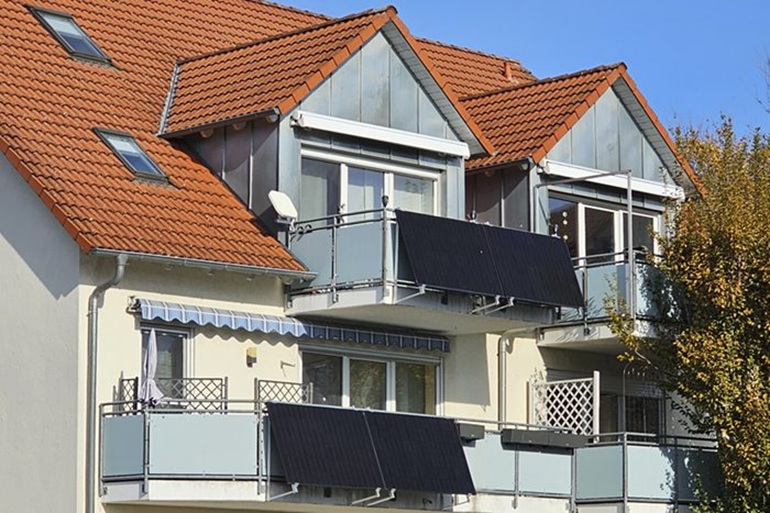
“Balcony” solar panels that you plug into an electrical outlet & generate your own power are widely available in Europe but not in the U.S. Credit: Nikolai Twin, CC BY 4.0.
Dear EarthTalk: Are plug-in “balcony solar” panels finally coming to America, and could renters really generate useful electricity with them?
—Gary Polton, New York, NY
Typically ranging from 400 watts to 1,200 watts of power output, plug-in balcony solar panels are small, portable systems that offer decentralized energy for renters, apartment dwellers and those who cannot afford rooftop arrays. Once plugged into a standard wall outlet, panels convert sunlight into household electricity via micro-inverters, which transform direct current (DC) electricity into alternating current (AC). They are already widespread in Europe, where Germany alone has over one million installed.
As of October 2026, 10 states have enacted legislation to enable plug-in solar use: Utah, Maine, Virginia, Colorado, Maryland, New Hampshire, Connecticut, Vermont, New Jersey and California. These laws permit plug-in systems without utility pre-approval, marking a wave of regulatory reconsideration and action now involving about half the states in the U.S. As Bright Saver co-founder Cora Stryker explains, while plug-in solar isn’t explicitly illegal in many places, current laws “were intended for rooftop systems five to 20 times as large.” Consequently, residents in states without enabling legislation often face interconnection applications and fees, making the process of installation both onerous and financially challenging. This could soon change: in early October 2026, Congress introduced the first federal balcony solar bill. If passed, it will require all state public utility commissions to consider rules of access and offer rebates for low-income households.
Plug-in solar is generally best understood as a supplement rather than a replacement for normal electricity services. A single 180W panel can generate up to around 270 kWh per year, helping offset baseline consumption by powering “always-on” appliances such as fridges, Wi-Fi routers and other standby devices. Jeff Meyer, energy expert and writer for The Independent, cautions that “It will not deliver the same savings as a larger rooftop array,” adding that not every property will have the right outdoor space, sunlight or permissions. However, a standard balcony kit can provide between $13 and $50 per month in savings on the low end, or $40 to $50 per month in high-rate states like New York and Hawaii.
To support the push for plug-in solar legislation, individuals can sign petitions, contact state representatives, and join organizations like Solar United Neighbors in advocating for change. Other strategies include donating to support energy freedom and writing to local newspapers to raise awareness of what electrical engineer Josh Pearce describes as a democratization of clean power: “the appeal of being able to make your own electricity, and for less money than you can buy it from a utility.”
CONTACTS
- Driving Plug-in Solar Legislation State by State
- Tell your state leaders to cosponsor a bill deregulating plug-in solar
EarthTalk® is produced by Roddy Scheer & Doug Moss for the 501(c)3 nonprofit EarthTalk. See more at https://emagazine.com. To donate, visit https//earthtalk.org. Send questions to: question@earthtalk.org.